Woodpeckers
The Adventures of Maya the BeeWoodpeckers are a powerful presence in the book’s forest: their method of feeding lets them reach insects hidden inside trees, turning bark beetles’ homes into vulnerable passages rather than secure refuges. Seen first through Maya’s startled response to drumming on a tree trunk and later through Fridolin’s account of his cousin Agatha, they embody a danger that can penetrate even the places insects consider safest. The story also places this threat within a larger ecological balance: bark beetles can destroy trees in numbers, while Woodpeckers prey on them.
Identity and Presence
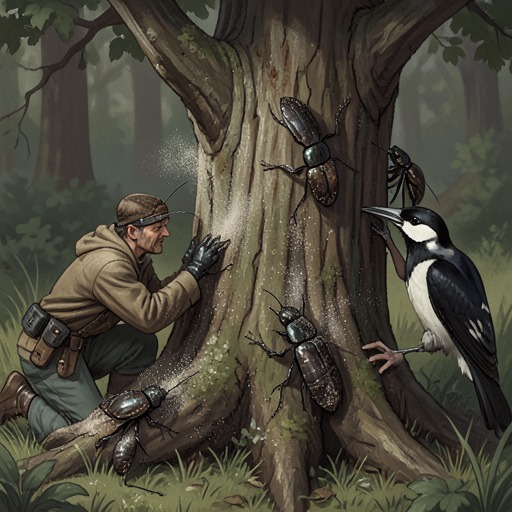
Woodpeckers enter the narrative as birds whose activity is heard before the animals themselves appear. Early one morning, Maya hears one drumming on the trunk where she has made her shelter. She has settled into a hole that is dry and warm, partly sealed its entrance with wax, and stored honey in a cool crevice at the back. The drumming is enough to send her away from the tree. Her reaction establishes how abruptly a familiar shelter can become unsafe when a larger animal searches its surface.
The danger is shaped by scale. For Maya, the sound from outside is alarming; for the insects living beneath the bark, the threat can reach inside their homes. Woodpeckers are therefore more than a distant hazard in the forest. Their feeding method makes the tree’s interior accessible to a predator that need not enter through the openings its occupants use.
Predation and the Tree’s Interior
Fridolin, a bark beetle, explains that the problem is not simply that Woodpeckers eat insects they find exposed on the bark. They can pursue their prey into the corridors and chambers where the beetles live. Their long, thin tongue is described as round, barbed, and sticky. Fridolin says it can extend to ten times his own length, reaching farther even when it seems to have reached its limit.
The bird probes cracks and crevices in the bark and pushes its tongue into the beetles’ passageways. Insects caught on it can then be pulled out of their homes. This account makes the Woodpecker’s tongue the decisive instrument of its reach: the bird’s size does not prevent it from searching narrow spaces, because its tongue can enter places the rest of its body cannot. What looks like shelter from the outside offers no reliable protection once the predator can explore its internal routes.
Fridolin draws a distinction between prey exposed on the bark and beetles reached inside their dwellings. He can accept that a Woodpecker must feed, but resents that it follows the beetles into the remotest parts of their homes. His complaint gives the account its tension: from the bird’s perspective, the corridors are feeding grounds; from the beetle’s, they are the last boundary of domestic safety.
Fridolin’s Account of Agatha
Fridolin’s explanation becomes personal when he recalls a visit from his cousin Agatha. She had not yet grown used to his household’s arrangements, and the two had recently quarrelled over his wife. As they were in their building, they heard a Woodpecker scratching and boring into it. Fridolin says that beetles usually have time to take shelter when they hear one approaching, but this bird had apparently begun at the building itself.
In the darkness, Fridolin heard Agatha call out that she was stuck. A short, desperate scuffle followed, then silence. Soon afterward, the Woodpecker was hammering at the neighbouring house. The sequence leaves Agatha’s fate unreported beyond her capture and disappearance; Fridolin remembers the call, the abrupt quiet, and the bird moving on. His recollection turns the bird’s feeding technique from general information into a specific family loss, while also showing how quickly an attack can end before anyone nearby can intervene.
Maya responds with alarm, thinking of her own past adventures and the accidents that might still await her. The story does not treat danger as an abstract feature of forest life: Fridolin’s carefully remembered episode gives it a voice, a victim, and a lasting emotional effect on its listener.
Ecological and Narrative Significance
The Woodpecker’s role is not presented as simply villainous. Fridolin acknowledges that birds must live, even as he objects to the reach of their feeding. The book’s account of bark beetles supplies another part of the relationship: when these beetles attack trees in large numbers, they destroy the bark and sapwood, the tissue that carries sap toward the branches, and whole forests may fall victim. The same beetles that are prey within the tree can threaten the tree itself. Woodpeckers thus occupy a position in a food relationship that is frightening to individual insects but situated within a wider natural order.
Their appearances also connect separate scales of experience. Maya’s retreat from a tree after hearing the drumming shows how the bird’s presence affects a small wanderer’s choice of shelter. Fridolin’s account explains why the sound is feared by the inhabitants beneath the bark, and why their elaborate corridors cannot guarantee safety. Together, these moments make Woodpeckers a recurring measure of vulnerability: the forest contains homes, but no home is wholly secure when a predator can reach through its walls.